

Alongside the shady banks of Uvas Creek in Gilroy lies a rich landscape steeped in history. Here, the land whispers stories of the indigenous Mutsun-speaking people. Chitactac-Adams Heritage County Park is not just a scenic stop. It is a preserved cultural landscape that enables education and reflection. Visitors can still walk the land the Mutsun-speaking people called home for thousands of years and connect with their history.
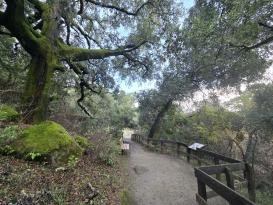
Historic Chitactac-Adams: A Sacred Place with Deep Roots
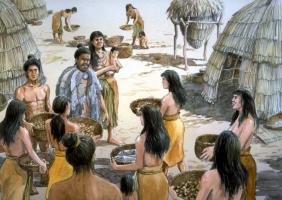
Long before ranches and orchards transformed Gilroy, Chitactac was a thriving village where the Mutsun-speaking Costanoan/Ohlone people raised their children, prepared meals, and conducted trade. The meaning of Chitactac translates into “place of gathering.” Here, the Mutsun-speakers hosted dances, ceremonies, and trade feasts near a large roundhouse central to the village.
Gilroy’s first inhabitants were spiritual and conscientious stewards of the land. They used thoughtful horticultural methods and controlled burns to manage the landscape. It was a rich and bountiful home, and the land provided for the Mutsun-speakers for generations. The native people applied their incredible knowledge of plants to medicine, food, and the creation of clothing and waterproof baskets made from plant fibers. Today, Mutsun-speakers still strive to preserve the land as their ancestors once did.
As time passed and new settlers arrived, the Chitactac site gained a second name: Adams. In 1859, local Sheriff John Hicks Adams built the first of two Adams schools. Fires destroyed both by 1956, but they were a gathering place for local students for many years. Because of this history, the Adams name is included in its modern title: Chitactac-Adams County Heritage Park.
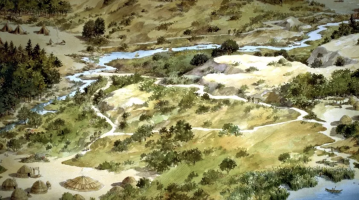
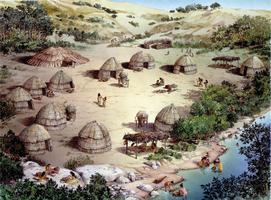
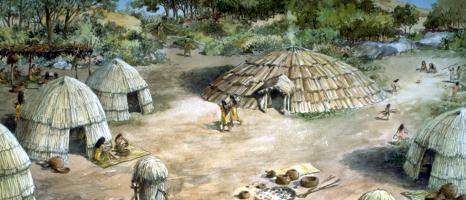
Photo and Illustration Courtesy of County of Santa Clara
Location, Location, Location: Chitactac & Gilroy as a Hub for History
Long before modern highways, Gilroy was at the heart of a vast Indigenous trade network that stretched hundreds of miles across California. Footpaths from the coast, the Central Valley, the Sierra, and far northern regions converged here, linking tribal communities such as the Chumash to the south, the Valley Yokuts and Sierra Miwok to the east, and the Coastal Miwok and Pomo to the north. Oral traditions even recall travelers arriving from as far as Oregon, Yosemite, and coastal villages up and down the Pacific.
Chitactac village itself was a vibrant cultural crossroads. The broader Costanoan/Ohlone world included eight distinct language groups, and over time, as many as 125 independent speaking Costanoan tribes lived in the region. Overlapping marriages, trade relationships, and social networks brought diverse groups together at this site, creating a multilingual, multicultural gathering place long before Spanish contact.
It’s easy to understand why Mutsun-speakers chose this spot. Nestled safely inland from the ocean, set beside a lush creek, and serving as a natural gateway between the Bay Area, the Central Valley, and southern California, the area offered abundant food, fresh water, and effortless travel in every direction. Just as it was thousands of years ago, Gilroy remains a thriving hub of connection between California’s landscapes and communities.
Why Visit? Immerse Yourself in Indigenous History
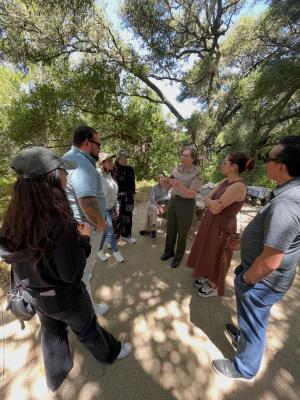
This park offers visitors the opportunity to slow down and experience rich cultural history not as a distant past, but as something still profoundly rooted in the land and its people. The trickling of the creek, the shade of the ancient oaks, and the earthy scent of native plants are the same elements that shaped daily life here for Mutsun-speakers long before Gilroy existed.
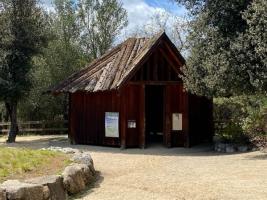
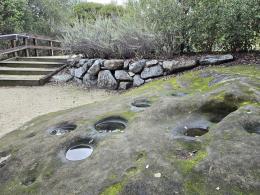
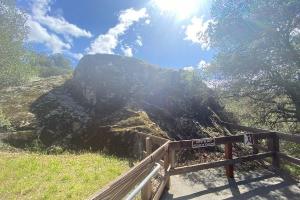
The park is home to culturally significant imprints of this ancestral life. Visible today are petroglyphs, or ancient rock carvings. The interpretive shelter preserves one of the park’s treasures: a large petroglyph that is estimated to be 3,000-5,000 years old. Together, the park represents one of the most significant collections of petroglyphs in Northern California. The indigenous people left behind 500 ancient bedrock mortars in the area, with about 50 of them located within the park.
The site’s high concentration of mortars establishes this location as one of the most significant heritage locations in the Bay Area. At one time, this area was home to 20-30 villages that extended as far north as the Pajaro River region. These ancient features serve as a reminder that this is not only a historic site, but also a sacred, ancestral home.
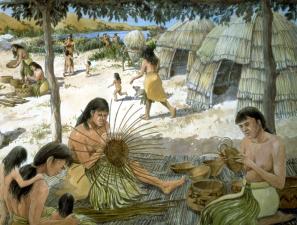
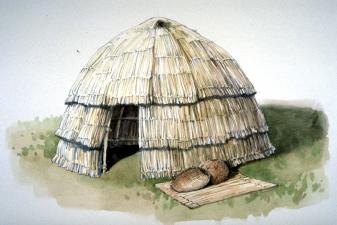
If visitors walk mindfully along the short trail, they may hear the echoes of the Mutsun-speaking people. One can visualize industrious women singing as they grind acorns, hazelnuts, and blackberries with their daughters and granddaughters to bake into bread or soup. Villagers might be busy gathering wild onions or buckeye nuts, or making baskets, tule boats, arrows, duck decoys, or tools. The smell of roasting meat, being cooked in underground pit ovens, would waft with the breeze near thatched, dome-shaped tule-and-grass homes. Men from neighboring native villages may have gathered to exchange shells, acorns, beads, obsidian, and salt, or perhaps hunt deer, game, or salmon. Dogs barking and children playing hoop games under wide-branching oak trees would set a playful backdrop to the village scene.
Planning Your Visit to Chitactac-Adams Heritage Park
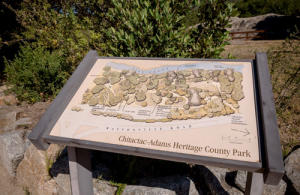
Chitactac-Adams Heritage Park features informative, bilingual interpretive signs that guide visitors along the ¼ loop trail. Visitors will learn about the park’s rich history, including informative displays about the Mutsun speakers’ culture, village, and food processing techniques, as well as the arrival of the Spanish, the era of the Ranchos, and the school days. Additionally, an interpretive shelter provides further details about the rich culture and daily life of the native people. Discover trade, language, social structure, and plant uses through engaging displays. The park offers both a great educational experience and a scenic nature walk that every family member is sure to enjoy. Visitors can explore the site in under an hour, but allow more time to reflect, picnic, or birdwatch.
Quick Facts:
- The park is open daily year-round, from 8 a.m. to sunset.
- Park entrance and parking are free.
- Restroom and hydration station on site.
- The park does not allow dogs.
- Accessibility: The trail is wheelchair-friendly to its halfway point. There are stairs leading to the lower part of the trail that are inaccessible to wheelchair users.
- Visitors must stay on marked pathways.
- Climbing on structures/rocks is prohibited for both safety and to protect the archeologically sensitive petroglyphs, bedrock mortars, and rock outcrops.
Visitors can find a park map here.
TO LEARN MORE ABOUT THE MUTSUN SPEAKING CULTURE, THEIR ANCESTRAL LANDS AND THEIR LIVES TODAY,
PLEASE VISIT: The Amah Mutsun Land Trust
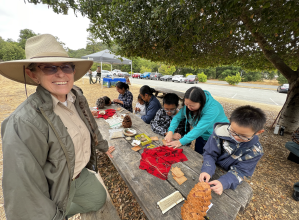
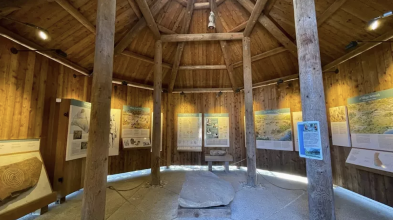
Photo Courtesy of the County of Santa Clara
Making the Most of Your Visit: Explore the Region
Visit Native California Showcases Native American Voices in California. Explore cultural experiences, art and history and learn about festivals and other sites you may visit.
Chitactac-Adams Heritage Park easily connects to a larger day trip through Gilroy and its surrounding landscape. As in earlier days, the area remains a valuable crossroads, connecting to local attractions and other historic sites.
Just a short drive away is Gilroy Gardens, a horticultural theme park that celebrates the valley’s agricultural roots, or visit Gilroy’s wine trail. Nearby Uvas Canyon County Park offers miles of trails for visitors to enjoy.
Visitors may consider visiting other nearby heritage sites to further their understanding of Indigenous culture. The treatment of Mutsun-speakers during the mission era was a difficult chapter in their history. Today, however, there is a statewide collaboration among scholars and Indigenous people to present exhibits at sites and museums that give a voice to the native people, incorporating their perspectives. Many nearby sites highlight Indigenous life, making for an enlightening day trip from Gilroy.
Nearby is Mission San Juan Bautista, the final resting place of Amah Mutsun medicine woman Ascencion Solorsano de Cervantes, remembered for her invaluable linguistic and cultural contributions. Santa Cruz Mission State Historic Park features the original Indigenous Mission housing and a museum that showcases their struggles during the mission era. Also in Santa Cruz is Sierra Azul Preserve and Mount Umumhum, the sacred site of the Mutsun speakers’ creation story. The de Saisset Museum in Santa Clara houses a permanent display of unique Native California artifacts. Mission San Francisco de Asis (Mission Dolores) features a geometric-patterned ceiling, hand-painted by Indigenous people using vegetable dyes. Some may extend their trip to Pinnacles National Park, home to the California Condor, a bird with deep significance in Mutsun-speaking history, or Yosemite National Park to learn more about California's cultural history and to enjoy the natural landscapes Indigenous communities once called home.
A Meaningful Stop in Gilroy
Chitactac-Adams Heritage County Park is a sacred site and cultural treasure that educates while preserving living history. It reminds us that history is not only something found in books, but also in the land itself: in the stones, the trees, and the pathways people have shaped with their footsteps, generation after generation.
The park honors the Mutsun-speaking people who first shaped this landscape. Visiting here is not just about learning history; it is about taking a moment to stand in it. So, the next time you come to Gilroy, don’t just drive past the hills. Step into them. Feel the culture and continuity of indigenous life that is still alive in Gilroy today.
Bibliography
Amah Mutsun Tribal Band. “Culture.” Accessed November, 2025. amahmutsun.org.
County of Santa Clara. “Chitactac-Adams Heritage County Park.” Accessed November, 2025. https://parks.santaclaracounty.gov/locations/chitactac-adams-heritage-county-park.
County of Santa Clara. “Healthy Trails.” Accessed November, 2025. https://stpfriends.org/HealthyTrails/HealthyTrails-GUIDE2.pdf?utm_source=chatgpt.com.
Gillette, Jane. Proceedings of the Society for California Archaeology 15. California Prehistory. Accessed November, 2025.https://www.californiaprehistory.com/publications/proceedings/Proceedings.15Gillette.pdf.
Golden Gate National Parks Conservancy. “Acorn Gathering: A Fall Tradition with a Long History.” Accessed November, 2025.
Ortiz, Beverly R. Ohlone Curriculum: Introduction and Teacher Resources. Accessed November, 2025. https://www.ramaytush.org/uploads/3/0/1/6/30165671/1_-_introduction___teacher_resources.pdf.
Salewske, Claudia. Images of America, Gilroy. (Arcadia Publishing: Chicago, IL, 2003) 10.
University of Texas Linguistics Research Center. “Hunter-Gatherer Lexical Features: Acorn Mush.” Accessed November, 2025 https://huntergatherer.la.utexas.edu/lexical/feature/601.
University of California, Berkeley. University of California Anthropological Records 54, “Trade Routes and Economic Exchange Among the Indians of California,” 10. Accessed October, 2025. https://digitalassets.lib.berkeley.edu/anthpubs/ucb/text/ucas054-001.pdf
