

A Deeper Look at Gilroy’s Rich History
From the ancient cultural significance of Chitactac-Adams Heritage County Park to the preserved stories found in local museums and historic sites, Gilroy’s past is layered, complex, and deeply rooted in California history. While many know Gilroy today for its agriculture and signature garlic legacy, there was a time when a very different crop defined the region.
In this guest contribution, Gilroy City Historian Toby A. Echelberry explores a lesser-known chapter in local history: when Gilroy briefly rose to prominence as the Tobacco Capital of the West Coast. This story highlights not only innovation and ambition, but also the cultural influences and labor that shaped the region during a transformative era.
Learn more about Gilroy’s rich history, and plan your stay.
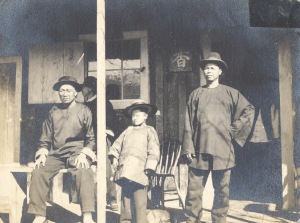
Photos of three men & child on porch. c 1898 Chinese New Year
Courtesy of Gilroy Historical Society
The Early Roots of Tobacco in California
Hard to imagine that there was a time in the distant past that Gilroy was considered the Tobacco Capital of the West Coast. In the 1860s and 1870s, California was a young and growing state, and the land was raw, and the soil was fertile. As the population of citizens who migrated from the dense East Coast cities grew, they came here at the opportunity for a fresh start where money provided more experience and chances at land ownership for those who could afford it.
Tobacco already had deep roots in California, being grown for centuries by indigenous people for uses in a wide variety of cultural practices including social gatherings, ceremonies, medicine, trading, and storytelling. There were four different tobacco plants which grew in California. The most common is called “Indian tobacco” (Nicotiana quadrivalvis) often referred to as the sacred tobacco. This tobacco, mainly used for medicinal and ceremonial practices, was known to be very strong in taste and extremely hard to inhale. As the name states, this tobacco was intended to be used with respect and honor where the tobacco would promote good health and assist with spiritual guidance.
The second common tobacco plant is called “coyote tobacco” (N. attenuate). This native wild tobacco plant grew as high as a meter with hairy, four-inch-long bladed leaves with tubular, trumpet-like pink or white flowers. It was mainly used as a hallucinogenic and to help alleviate pain.
For the Ohlone tribes including the Amah Mutsun, tobacco usage was mainly for sacred and ceremonial purposes. During one of the Portola expeditions, Juan Crespi even wrote in his diary that they were greeted and well fed and given native tobacco. The Spaniards would often trade with local indigenous tribes with their own Spanish tobacco and glass beads. This was documented by Fr. Pedro Font during the 1776 expedition led by Juan Bautista de Anza where he wrote there was “a good deal” of native tobacco growing in the plains to the east of present-day San Francisco.
As time went on and the Spanish missions and presidios were built, one of the prosperous crops to obtain was tobacco. Archaeologists have found several instances and accounts of tobacco cultivation. Recent excavations surrounding Mission Santa Clara de Asis even discovered an assemblage of charred and uncharred tobacco seeds. While they had gathered wild tobacco crops, they also discovered fields would be burnt and fresh tobacco plants grown in the charred soil to harvest a rich crop the next year.
Coyote tobacco was the predominant tobacco of choice but there were also discoveries of foreign tobacco being grown at the missions as well. In Southern California there are reports of “manyflower tobacco” and “tree tobacco.” In Northern California regions, what is known as Chinese tobacco was found near Mission San Juan Bautista.
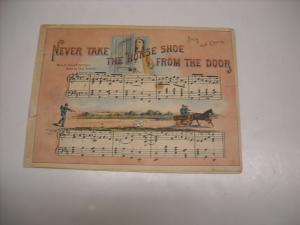
Music sheet; "Never Take The Horse Shoe From The Door". Words By Edward Harrigan, Music by Dave Braham. Song & Chorus. Published to advertise Drummond Horse Shoe & Plug Tobacco company
Courtesy of Gilroy Historical Society
The Rise of Gilroy’s Tobacco Industry
Fast-forward to a century later, when the vast land surrounding the small, bustling city of Gilroy was soon to be destined for greatness. James Darius Culp, born in 1839 in New York, arrived in San Francisco in 1859, and surveyed the area for a suitable spot for growing his own tobacco venture, as tobacco at the time was a booming business. He eventually made his way sixty miles south to the bustling city of Gilroy. The lands in San Felipe were rich and a fertile location to grow his tobacco plants.
Culp had various different tobacco plants as each variety had its end use products such as cigars, loose tobacco or even chewing tobacco. Culp not only grew the tobacco but was working on ways to raise from Havana seed to drying and curing. He built his first factory in 1862 a couple of miles outside of Gilroy, but in 1865 it burned to the ground one night.
Culp went back up to San Francisco, with a patent in process and a vision in hand. He arranged a handful of investors and raised $250,000 in capital, thus creating the American Tobacco Company. It was here he announced his plans for the development of a cigar factory to be built in Gilroy. Since the railroad had reached Gilroy a couple of years prior in 1869 as part of the vast Transcontinental Railroad system, he sold everyone on the vision of seeds to cigar boxes with mass production shipping all over the nation.
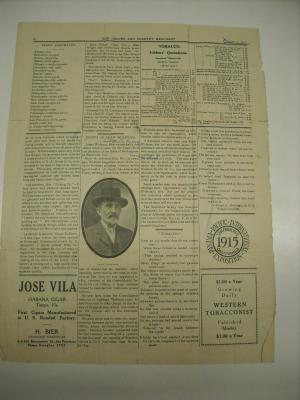
A page from a trade paper called "The Grocer and Country Merchant," page 22 dated April 17, 1914. Obituary of Adam Wolfram, one time foreman of Consolidated Tobacco Company of Gilroy. One page. 13.5 X 10.5
Courtesy of Gilroy Historical Society
Innovation, Expansion, and Labor
This building near the train depot built out of brick served as his factory where he could dry, package and manufacture his products. Soon after the factory was up and running, he started touting that this would be the world’s largest factory and would produce over two million cigars per month. Culp soon merged with the Pacific Tobacco Manufacturing Company and called it the Consolidated Tobacco Company.
In 1872 he filed a patent for his process and by 1874 that patent was approved. The patent was for a process that more effectively cured locally grown Havana tobacco leaves to be used for chewing-tobacco; it consisted of fermenting the tobacco before it is dried, and by one fermentation only, enabling the preservation of a larger proportion of the saccharine matter produced during curing.
Culp’s success wasn’t all his own: He did all of this with the assistance of Chinese immigrant laborers whose contributions remain both pivotal and underrecognized. He was already hiring Chinese immigrant laborers for work on the farm but now needed more workers for his factory, too.
Chinese workers had immigrated to the Bay Area to help build railroads and work in gold mines, tobacco fields, and growing orchards. By the 1870s, the majority of the agricultural workers in California were Chinese. During this time, Gilroy’s Chinatown (two-block section of the village along Monterey Street) boomed. Chinese residents who did not work on farms owned or worked at businesses along Monterey Street, which included laundries, restaurants, saloons, gambling houses, drug retreats, and at least one brothel. At its peak, Gilroy’s Chinatown had over 1,000 residents.
Before Culp new it, he was working hand-in-hand with a couple of Chinese bosses (Ah Tyng and Ah Quin) providing him all the necessary labor needed for his vast growing empire. The Chinese bosses brought 140 more men from San Francisco to help in the factory. Culp said he liked using Chinese laborers as their hands were smaller than most and could easily roll his little cerut cigars.
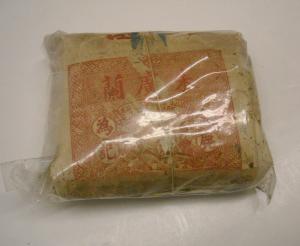
Package of Chinese tobacco wrapped in Chinese wrapping paper. Made in Chine. Found by Harry Lesley in the Gilroy Chinese Temple.
Courtesy of Gilroy Historical Society
From Boom to Bust
Business was booming, and because of Gilroy’s climate, Culp was able to harvest three harvests per season. At one point there were 900 Chinese immigrants laboring in his business who grew, harvested, and cured 1.5 million pounds of tobacco annually. This translated into 200,000 cigars per month and 10,000 pounds as chewing or loose pack tobacco. At its peak, Culp was up to 1 million cigars per month. Business was so good Culp was looking to add a second floor to the factory and a three-story building next to the one currently there.
Gilroy was bustling and was to be known as the Tobacco Capital of the United States. Unfortunately, as all great things do, the rise of Gilroy’s tobacco industry came to an abrupt halt with the Panic of 1873, a global financial crisis that triggered a deep and prolonged depression. The panic was sparked by the collapse of Jay Cooke & Company, a major investment bank that had overextended itself financing railroad construction.
As the banking system buckled, a credit crisis followed, freezing loans and drying up investments. Unemployment soared, factories closed, and consumer spending plummeted. In Gilroy, demand for cigars, then considered a luxury item, collapsed.
As if economic hardship weren't enough, Chinese laborers, who had built the industry became targets of escalating racial hostility. This culminated in the 1879 revision of the California Constitution, which prohibited Chinese workers from employment in corporations or on public projects.
The law directly impacted the Consolidated Tobacco Company, which had become entirely dependent on Chinese labor. Culp during this time, tried downsizing several times and then in the end shuttered the factory in 1882. Culp kept his tobacco farm going until 1926, when he finally sold the land as well.
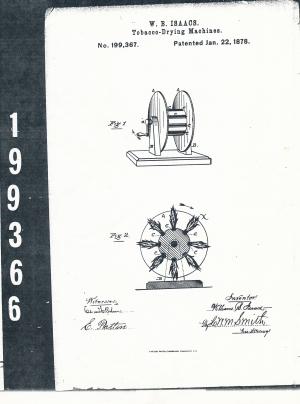
Copy of W.B. Isaacs’ patent
Courtesy of Gilroy Historical Society
Explore Gilroy’s History & Culture
Step into Gilroy’s past and discover the stories that shaped this community, from its agricultural roots to the people and cultures that helped it grow. Explore local history at sites like Chitactac-Adams Heritage County Park, visit museums, and stroll through downtown where echoes of these earlier eras still linger. Whether you're a history buff or just curious to learn something new, Gilroy offers a deeper connection to California’s evolving story.
Make it more than a day trip. Plan your stay, explore local shops and restaurants, and experience the charm that continues to define Gilroy today. From historic landmarks to modern-day flavors, there’s always more to uncover. Start planning your visit and see how the past and present come together in Gilroy.
